PAX
DONA NOBIS
PACEM
A SERIES OF
ENCRYPTED PAINTINGS
BY JEAN-CLAUDE BOSSEL
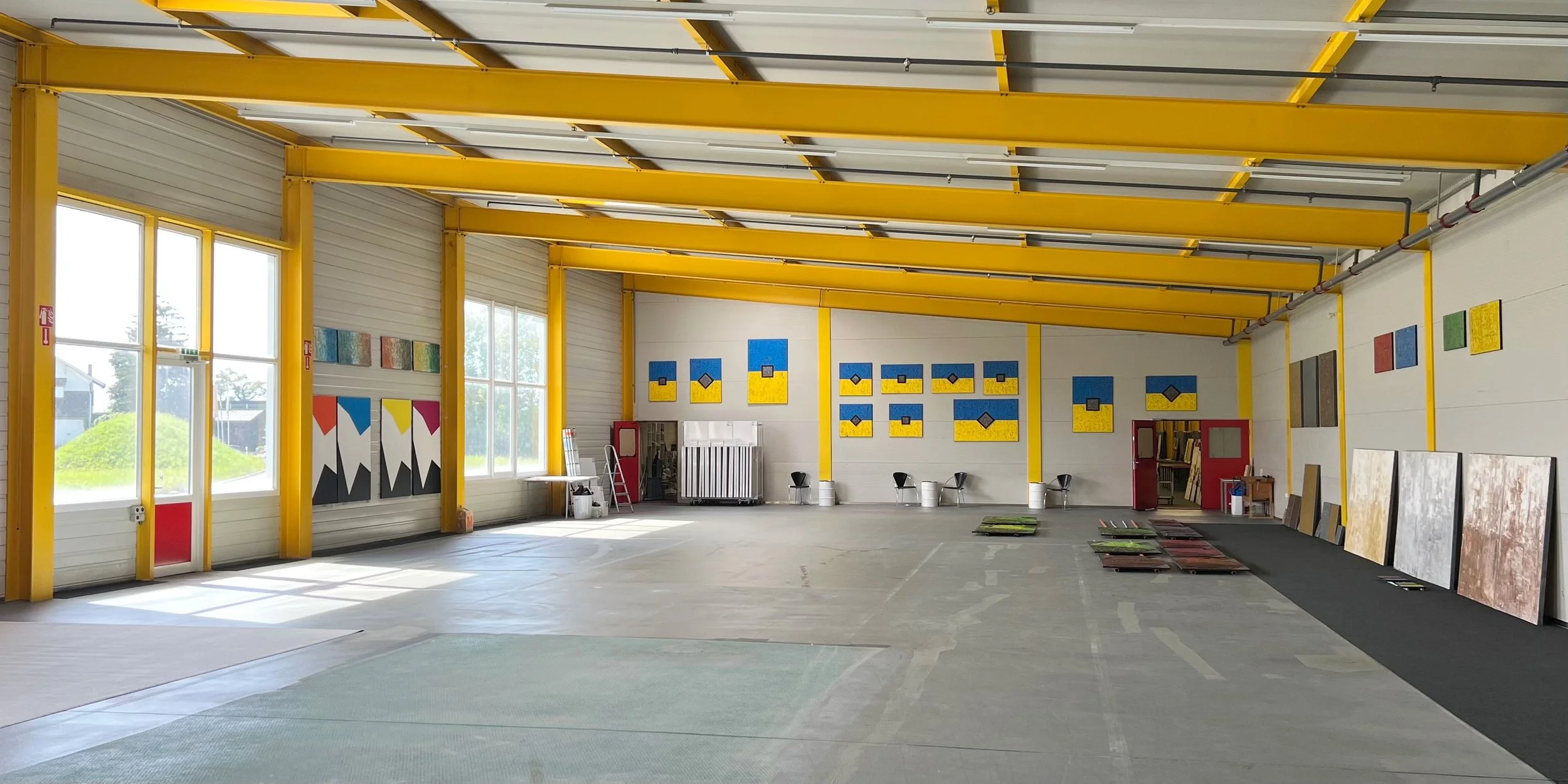
The twelve paintings in the PAX series,
displayed on the back wall of one of the
three sections of our former 2,000 m² studio showroom
in the industrial district of Préverenges, Switzerland.
Private documentary photograph
© FGB GALLERY
Préverenges, Switzerland, September 2025
SOURCE OF INSPIRATION
FOR THE
PAX series
Detail of the centre
of the paintings
in the PAX series
ARTIST’S
STATEMENT
“Like many Europeans, I was deeply affected by the entry of the Russian army into Ukraine at the beginning of 2022, even from my peaceful region of Switzerland, thousands of kilometres away.
I quickly realised that the geopolitical situation was complex, rooted in a long and painful history, with old disputes and deeply entrenched resentments.
To fully grasp its significance, one would probably have to go back at least to the end of the Second World War.
But beyond the geopolitical issues, it was above all the people themselves who occupied my thoughts: those under bombardment, living in fear, enduring violence and loss every single day.
I imagined their wheat fields, suddenly covered with metal and blood. Images came back to me, notably those of the First World War memorial sites I had recently visited at the Chemin des Dames and Verdun.
DONA NOBIS PACEM.
1 September 1939
1 September 2025”
hidden MESSAGES
encrypted in THE
PAINTINGS
The surfaces of the PAX paintings may evoke bullet impacts, scars, knife cuts, or even traces of bayonets from past wars.
These marks also represent messages encrypted using CODE BACH® through variations in the shape, length and colour of the marks.
Each of the twelve paintings contains encrypted messages.
One of them is the Latin phrase DONA NOBIS PACEM.
Ignore the small grey holes and look only at the black or red holes and slits.
Start with the colours: black represents 0 and red represents 1.
The image shows several vertical sequences of five binary digits, each read from top to bottom.
The leftmost sequence reads 00111.
Now read the same five marks by shape.
A hole represents 0 and a slit represents 1.
The sequence then reads 10000.
In the upper left of this image, you can see longer slits and additional colours.
This time, a hole represents 0, a short slit represents 1, a medium-length slit represents 2, and a long slit represents 3.
Read each of the two groups of three marks on the left from top to bottom.
The two sequences are 130 and 220.
Now read the same marks in the same order, this time by colour.
Black represents 0, red represents 1, blue represents 2, and yellow represents 3.
The two sequences now read 210 and 300, respectively.
ART &
MATHEMATICS
Before painting, Jean-Claude Bossel used the CODE BACH® process to determine the sizes, shapes and colours of the marks on the canvas.
He first converted the chosen messages into sequences of digits in base 2 or base 4.
He then encrypted these sequences through further calculations.
Finally, he represented the encrypted digits on the canvas using holes and slits, with variations in slit length and colour.
the twelve paintings
of the pax series
Acrylic on canvas, various dimensions.
A small square canvas glued onto the main canvas.
Glue, wheat grains and metal waste.
Painted in 2025.
70 x 100 cm
80 x 110 cm
100 x 160 cm
80 x 80 cm
100 x 70 cm
100 x 70 cm
80 x 80 cm
80 x 80 cm
80 x 80 cm
150 x 100 cm
90 x 130 cm
110 x 80 cm
ENCRYPTED MESSAGES
SPANNING ALL TWELVE
PAX PAINTINGS
In addition, other encrypted messages run across all twelve paintings, from No. 1 to No. 12, continuing from one canvas to the next.
One of these messages draws on Friedrich Schiller’s Ode to Joy, set to music by Beethoven in his Ninth Symphony.
Its celebrated melody now serves as the European anthem.
ALLE MENSCHEN WERDEN BRÜDER